
Ciao splendida Sole !
Abbiamo visionato il sito e l abbiamo trovato fatto molto bene e interessante, riteniamo che sia di facile comprensione e con tutte le...
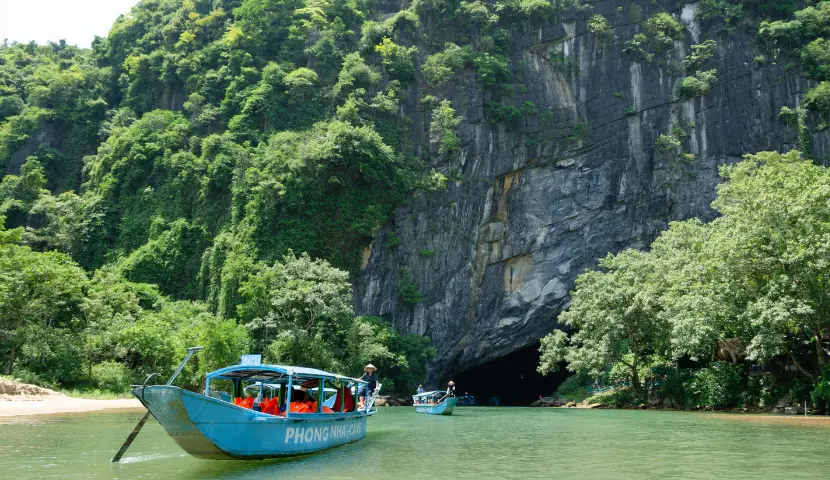
Phong Nha is not just about caves - Phong Nha has stone, water, ancient forests, and history flowing through the heart of Quang Binh. A complex of caves in Phong Nha - Ke Bang National Park, the world’s longest underground river, million year old stalactites. People say, “If you go to Phong Nha and have not taken a boat into the cave, kayaked on Chay River, or eaten grilled chicken with salt dip, you have not really been there.” Phong Nha is majestic, pristine, and mysterious, like the whisper of limestone mountains in the great forest.
1. The history of Phong Nha
2. Geographical
3. Caves Cluster in Phong Nha
4. Rivers, streams & forest in Phong Nha
5. Spiritual & historical site in Phong Nha
6. Phong Nha cuisine
7. Culture & people of Phong Nha
8. How to get to Phong Nha
This land was once the edge of the Champa Kingdom. The Cham people called this area “sacred mountain.” Cham script on the walls of Phong Nha Cave proves that ancient people entered for worship as early as the 9th century. Vietnamese people began settling villages here during the Le Dynasty, naming it “Phong Nha” because the cave entrance looked like teeth with wind blowing through.
In 1899, during French colonial times, a French explorer discovered the cave and named it “Vòm Cave.” Phong Nha appeared on Indochina tourist maps in 1924. The caves became bomb shelters, supply depots, and field hospitals during the wars. The western branch of the Ho Chi Minh Trail ran through here. In 1972, Eight Heroes Cave is where eight youth volunteers died – now a sacred memorial shrine.
Phong Nha - Ke Bang National Park was recognized by UNESCO as a World Natural Heritage Site for the first time for its geology in 2003. It was recognized a second time for biodiversity in 2015. A British expedition team found Son Doong – the largest cave in the world In 2009. Phong Nha became the “kingdom of caves” with 500 caves and 200 km of surveyed length from a “small cave”. Phong Nha became Vietnam’s pride from a hiding place.
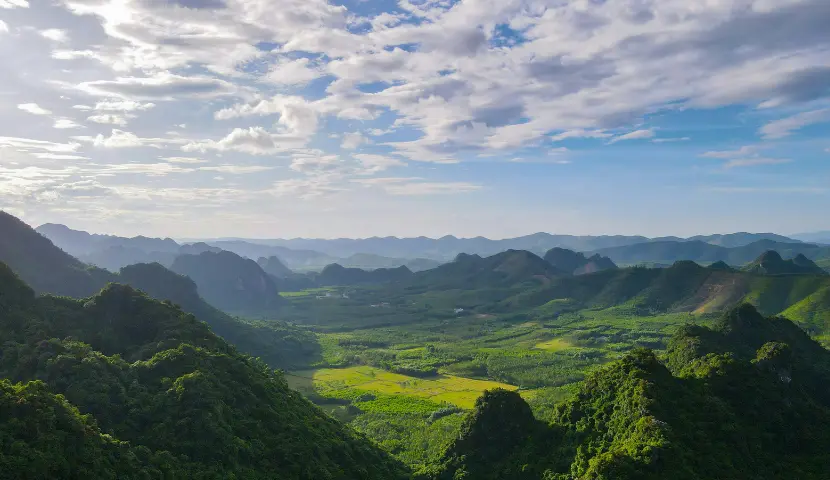
In Asia, the terrain is the oldest limestone massif, 400 million years old. U Bo Peak at 1,009m, Co Rilata Peak at 1,128m rise and fall. Beneath the rock is a tangled system of underground rivers including Chay River, Son River, and Trooc River. Almost 104 km of caves have been surveyed, but hundreds more kilometers remain untouched.
Forests cover 96% of the area which is the rarest primary forest on limestone in the world. There are sao, kien kien, and 500 year old lim trees. There are Hatinh langurs, saola, and giant muntjac or rare animals found only here. There are 2,700 plant species and 800 animal species.
Getting to Phong Nha is easy now. From Dong Hoi, it is a 45 minute drive on the eastern branch of the Ho Chi Minh Highway. Dong Hoi Airport has flights from HCMC and Hanoi. You can rent a motorbike in Phong Nha and ride between the mountains – cliffs on one side, river on the other – breathtakingly beautiful.
When you’re in Phong Nha, you have to go into the caves.
Phong Nha Cave
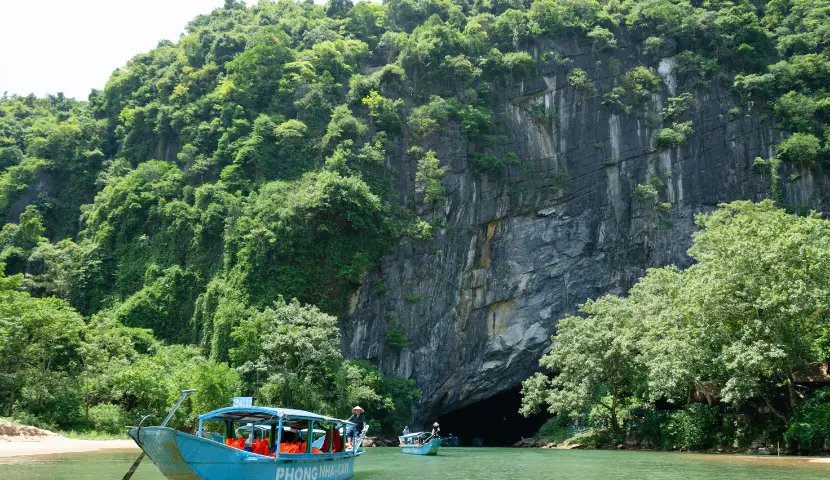
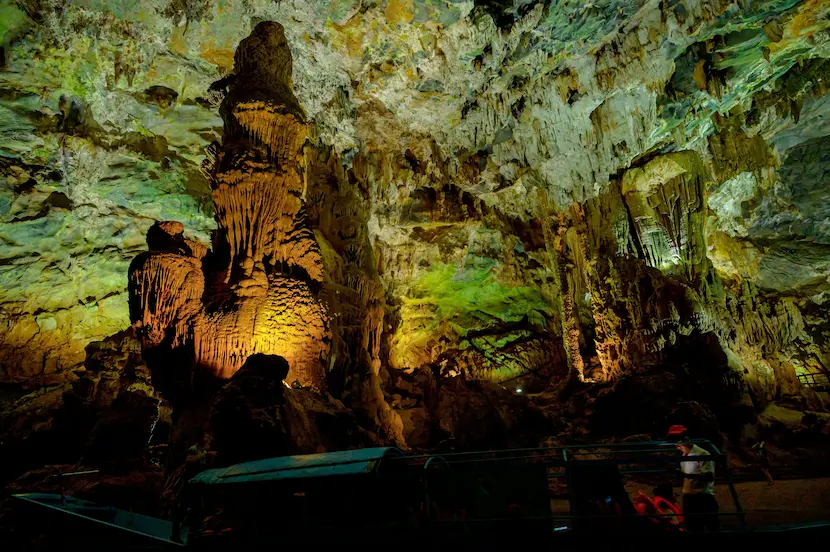
It is a wet cave 7,729m long, with the world’s longest underground river. You can buy a ticket, take a dragon boat for 30 minutes upstream on the Son River to the cave entrance. You should turn off the engine, row by hand, headlamps lighting up the stalactites. “Lion,” “Qilin,” “Royal Court,” “Fairy Land” – stone shaped by dripping water over millennia. You can go the first 1 km, or if you’re fit, kayak 4.5 km deep.
Tien Son Cave
It is located above Phong Nha Cave, climbing 330 steps. A dry cave with stalactites like terraced fields, stone columns, and fairy streams. You can stand at the entrance and look down at the Son River and the boats look like leaves.
Paradise Cave
It is 31.4 km long, the longest in Asia, but tours cover 1 km on a wooden walkway. The ceiling is 100m high, with stalagmite columns up to 80m. Walking inside feels like landing on another planet so for trekkers, there is a 7 km deep tour with underground stream wading and overnight camping.
Dark Cave
You have to zipline 400m across Chay River, then kayak in. Inside, it is pitch black, with mineral mud up to your knees. After a natural mud bath, wash off in the Chay River, you will feel light as air.
En Cave
It is the third largest in the world. A 2D1N trek through forest and streams, camping inside the cave. The ceiling is 100m high, with a sand beach and lake. Tens of thousands of swifts return here, at dusk they fill the sky.
Son Doong
It is the largest cave in the world at 200m high, 150m wide, and 9km long. It has its own forest, river, and clouds inside. The 4D3N tour only takes 1,000 guests per year and must be booked a year ahead. It is expensive indeed, but it’s a once in a lifetime trip.
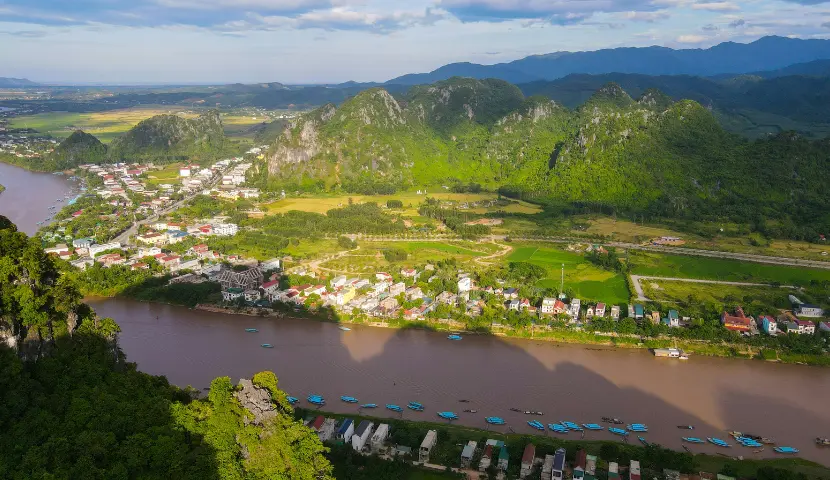
It is not just caves. Phong Nha has water too.
Chay River Dark Cave
It has the hottest combo. Zipline across the river, mud bath in Dark Cave, kayak, float, zipline back into the river. Chay River water is jade green from limestone, 18°C even at summer noon.
Water gushes from the mountain, ice-cold and emerald in mooc spring. There are bamboo bridges, kayaks, and spring swimming. You can fish nibble your feet or eat grilled chicken and sticky rice in leaf huts in the forest.
Bong Lai Valley
“Little Vietnam.” Country roads, wooden houses, corn fields. You can drink goat milk and eat hill chicken at The Duck Stop. Or you can ride a motorbike across a suspension bridge, through lush meadows.
Ozo Park
It is the longest treetop park in Vietnam. You can walk 999m on a wooden deck through the forest, play high ropes courses, SUP on the stream. Ancient lim forest, clean air.
Botanical Garden
It has a light 4 km trek, see 100-year-old sao trees and the 30m Gio Waterfall. There is a language and monkey rescue center. Great for families and kids.
Son River boat ride: At 5 PM, rent a boat and head upstream from Phong Nha. Limestone mountains on both sides, countryside, water buffalo wallowing. Sunset spills gold across the water.
This land is sacred because much blood was shed here.
In 1972, eight Heroes Cave had eight youth volunteers who hid from bombs and were buried by rockfall. Now a shrine with incense burning day and night. You can light a stick, hear the stories, and tears come naturally.
Xuan Son Ferry Terminal is the legendary Ho Chi Minh Trail. The old ferry terminal, tank and artillery relics. You can stand here looking at the Son River to understand why soldiers called it the “bomb pocket.”
National Park Exhibition House: See 400-million-year-old fossils, a model of Son Doong, and saola specimens. And you can understand why UNESCO recognized it twice.
Non Pagoda or Than Dinh Mountain is 15 km away. Ancient pagoda on a 342m mountain, 126 steps. Legend says there is a Buddha footprint. You can climb up, look down over Quang Binh’s plains and the wind is wild.
Lieu Hanh Princess Temple: At Da Deo Pass. A temple for Princess Lieu Hanh, very sacred. Drivers crossing the pass always stop to pray for safety.
Phong Nha cuisine is rustic but rich.
Grilled hill chicken
It has free range, firm meat. You can marinated with honey, grilled over charcoal. You can dip in cheo salt, salt, green chili, lime leaves, and wild pepper pounded together. Best at Mooc Spring and East Hill.
Son River grass carp
It has wild river fish, grilled whole or cooked in sour soup. It is sweet, chewy meat. You can wrap in fig leaves, dip in fermented fish sauce.
River shrimp, rock crab
It is chay river shrimp grilled, rock crab with tamarind. Crabs are small but full of golden roe and firm.
Highland pork platter
It has black pork, hill chicken, upland sticky rice, forest greens. One platter serves four. You can dip in cheo salt, drink corn wine.
Red rice banh xeo
It has Phong Nha red rice and makes a crispy crepe. It is filled with river shrimp and baby shrimp. You can wrap in mustard greens, dip in fish sauce or eat at Phong Nha market early in the morning.
Chao canh
It is rice noodles with snakehead fish, shrimp, crab. It is cloudy, sweet broth. A bowl in the morning warms you up for the caves.
Tram mushrooms
They are in the rainy season, and mushrooms grow in tram forests. You can cook it with chicken porridge or stir-fried with beef. It is bitter at first, sweet aftertaste.
Forest honey
It has wild bees nests on cliff faces. It is golden, fragrant, not cloyingly sweet. You can buy at the forest edge from locals.
Minh Hoa corn wine
It is brewed by the Nguon people with leaf yeast. It is smooth, gets you drunk before you know it. It is perfect for nights by the Son River.
Khoai deo, boiled peanuts
Khoai deo is chewy and sweet, boiled peanuts are nutty. It is a cheap, tasty road snack.
Phong Nha people are “as genuine as stone.” The town has only 3,000 people, everyone knows each other. Morning greeting: “Where are you going?” Evening: “Drinking?” Kind, honest, no price gouging. You can ask for directions, they will drop work to guide you. A bike breaks down in the forest, the whole village comes to push.
This land has Kinh, Bru-Van Kieu, and Chut people. Arem Village in the park still keeps stilt houses and gongs. The “Lap Lo” New Year in April worships the forest and drinks rice wine.
Main jobs are farming, tourism, and forest work. Men row boats and porters for caves. Women run shops and homestays. Kids swim in the Son River at 5, know every stalactite name by 10.
Phong Nha people love and protect the forest and caves. You can break a stalactite, they will scold you. If they see plastic in the river, they will fish it out. “The caves feed us, we must protect them,” they say.
In Phong Nha, you learn “enough is enough.” No bars, no malls. The town sleeps by 8 PM. But at 4 AM roosters crow, and the river shows you a peaceful life. Phong Nha people often say “slowly,” “you will get there eventually.” Yeah, once you are in the cave, what is the rush?
From Hanoi: Fly 1h20m to Dong Hoi Airport, round trip 1.5-3 million VND. From the airport to Phong Nha is 45 km, taxi 45 minutes, bus 40k/ticket.
Train SE 10-11 hours, 400k-900k/ticket, stop at Dong Hoi Station then taxi 45 km in.
Sleeper bus 10-11 hours overnight, 250k-350k/ticket, Hung Long and Queen Cafe run 6-8 PM.
From HCMC: Fly 1h30m to Dong Hoi, round trip 1.8-3.5 million VND.
By motorbike/car: From Hanoi take Highway 1A or Ho Chi Minh Highway 500 km, 9-10 hours. HCM Highway is empty and beautiful, crossing Da Deo Pass.
From Dong Hoi to Phong Nha: Rent a motorbike 150k-180k/day, car 600k-800k/day. Road 20 Quyet Thang to Phong Nha is 50 km – mountains on one side, river on the other. Ride slowly and take in the view.
Related articles: